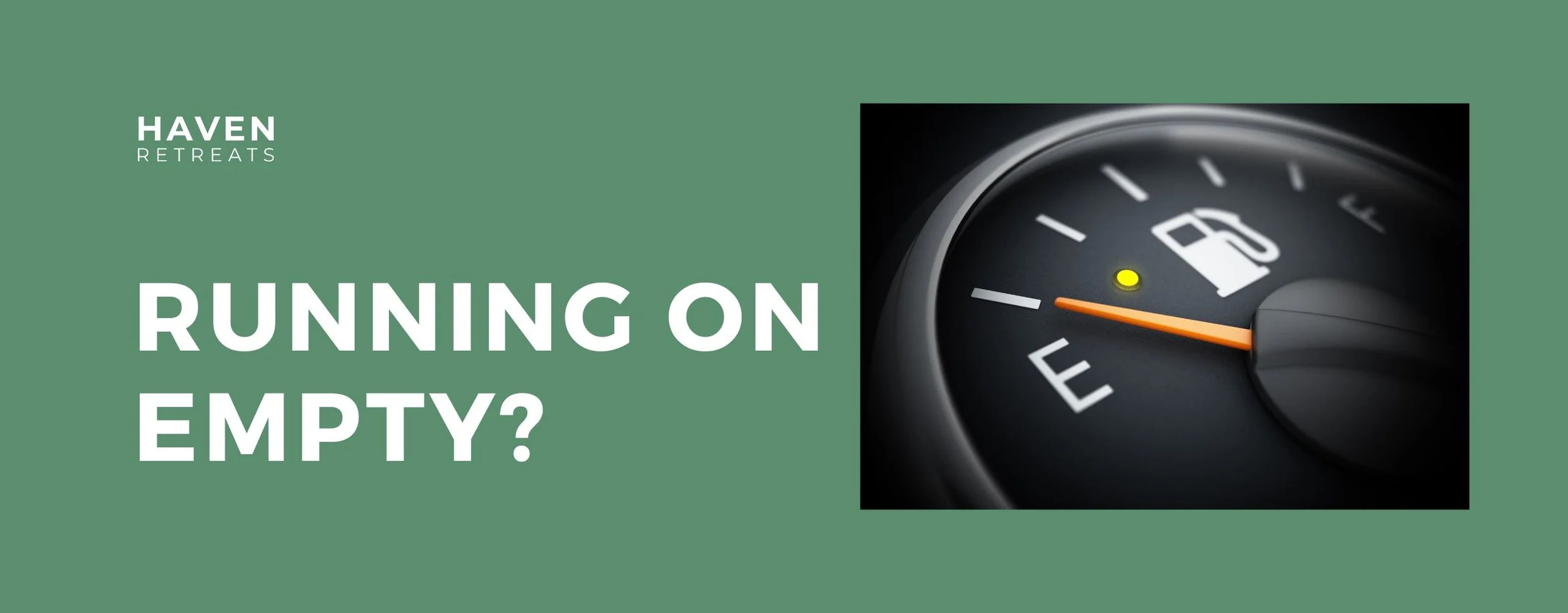
Running on Empty?
Last week, I shared a story about a moment that changed the way I think about my life. If you missed it, you can go back and read it here.
But here’s the thing I didn’t fully understand in that moment…Moving from drowning to thriving is a massive leap.
When you’re exhausted, overwhelmed, and barely keeping your head above water, the idea of thriving can feel so far away that it’s almost discouraging. It’s like standing at the bottom of a mountain and being told the goal is the summit. Technically true… but not immediately helpful. Over time, I’ve realized there’s a much more important step in between those two places.
Sustainability.
If you think about life in circular terms - or peaks and valleys - sustainability is the place between drowning and thriving. The interesting thing is that this feels very different moving from drowning towards thriving… on that upwards curve, it’s the first breath of air in a really long time. On the downward curve, it’s just shy of thriving - but not noticeably drifting downwards yet. It’s the place where life may feel hard, but it’s not crushing you. We’re going to get to thriving… I promise you, it’s possible… but we’re going to pay attention to sustainability. Why? Because it matters more than we often admit.
So, let’s hold onto the question, “What would it look like to thrive here?” and add another question: “If nothing about your circumstances changes, what would you need to keep going? Not your kids. Not your family. You. Just you.”
That question requires awareness. What is currently working? What isn’t?
Statistically, there are a few areas that matter the most. Here are three of them: community, healthy boundaries, and pace. Let’s talk about them…
Community.
Isolation is one of the fastest ways to drown in this work. You don’t need a huge group of people, but I would love for you to have at least 2 or 3… honestly, I’d settle for just one. The true caveat is that you have to be able to be brutally honest with them and know that they’re not going to judge you. You have to be able to say all the hard, scary feelings that you have and know that they know that you still love your kids. For me, I’ve got people inside my adoption circle like this and… more importantly… outside of my adoption circle. Both are important for different reasons.
Boundaries around what you carry.
Our job is to faithfully show up for the work in front of us. But it’s not our job to carry the full weight of every broken system, every family’s story, or every outcome. It’s not even our job to carry the burden of “fixing” or “healing” the behaviors and traumas that our children have and have experienced. This one took me a significant amount of time to learn, and it’s ok that it takes time. Get really honest here… what is yours to carry, and what isn’t? What burdens have you picked up that are overwhelming you to the point of burnout? Is it possible to put them down?
Pace.
This life is not a sprint. It’s much closer to an ultramarathon. And we cannot sprint our way through an ultramarathon. Think about your schedule. Think about your kid’s schedules… include not just sports, but therapies in that equation. You are the gatekeeper… what’s the right pace for your family? Not what you’ve told yourself they need… but what’s truly the right pace? That might be some hard conversations. In our family, that looks like saying no to travel sports for our baseball-loving 13-year-old, and last fall, it meant pulling out of therapies that weren’t vital to our younger 4’s development. Those were hard conversations for me, but it was the right decision for our family. But, more than that - and back to the ultramarathon example - we have to prioritize rest. It’s essential to longevity in this work.
Which one of these three do you already have in your life? Which one do you need to add?